Pokémon Go
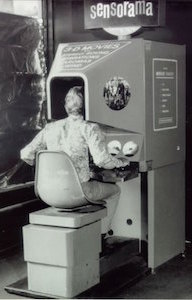
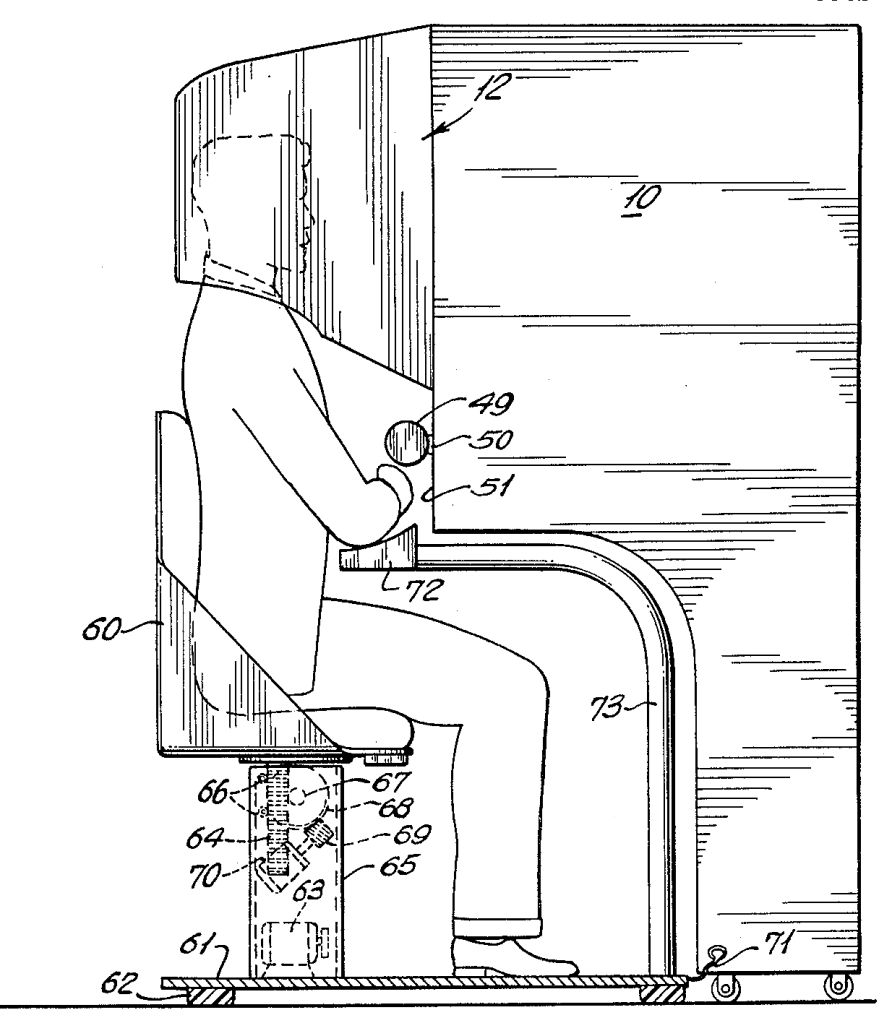
the Sensorama design by Morton Heilig
What is Virtual and Augmented Reality?
Vr and AR
Virtual and Augmented Reality simulates experiences that can either be similar to the real world or can be a complete contrast to it. while used mostly to play games or enjoy the virtual experience, there are more scientific uses for this technology. The entertainment aspect of virtual reality can cause an almost real effect of immersion also called ‘telepresence’ or the illusion of being there. Many other types of virtual reality can be more than a headset and controllers, Flight simulators used by pilots use life size cockpits to immerse the pilot in the simulation.
Augmented reality is an experience where designers enhance parts of the user’s physical world with computer generated inputs. Examples such as Pokémon go is a prime example where the user physically walks around and interacts with their surroundings finding Pokémon. Augmented reality is mostly seen as a way to get exercise whilst also playing games, in other cases, it is seen as a danger hazard as people can walk into restricted areas or into oncoming traffic. Augmented reality isn’t always used for playing games on phones, applications like snapchat or TikTok use ‘filters’ to add extra detail to a short video or a photo that someone takes of themselves, this feature of augmented reality is very popular on phones and is used very commonly.
Technical Information
Virtual reality is designed to replace our physical surroundings with something created in software, this is most commonly done through a VR headset, this device Is small and can be used almost anywhere as long as there is space to move around your hands, and stimulates your sight and hearing, two controllers shaped like TV remotes simulate hand movements and are tracked by the headset. Touch can also be simulated using a Haptic vest, the user wears the device when using the device (commonly use when playing video games) and the vest vibrates in certain areas depending on where the software interacts with the device. VR headsets come with a gyroscopic sensor that detects and senses angular velocity or when you turn or twist your head around and manometers which detect movement speed and direction.
Augmented reality starts with a camera equipped device, such as a smart phone, tablet or smart glasses loaded with AR software, when the user points and looks at an object, the software recognises it through computer vision technology, which analyses the stream. The device downloads information about the AR program similar to a web browser, however the AR information is presented in a 3D experience allowing a part real part digital experience. Because augmented reality is often in pair with smart devices, as long as it has a camera and has mapping, like google maps it can use augmented reality.
Historical Information
The beginning of Virtual reality is very different from the electronics we know today, starting in 1838 with stereoscopic photos. Invented by Charles Wheatstone, the stereoscope gave the viewer a sense of depth and immersion out of two separate two dimensional images. In the 1950’s Morton Heilig’s ‘Sensorama’ was developed, it appeared in an arcade style fashion that would encase the users head for a higher quality viewing experience, the chair was also connected to the Sensorama and would vibrate and change height, the device stimulates other senses such as touch with fans blowing air onto the user’s skin and stereo speakers. Morton Heilig would then go on to make the first head mounted display in 1960, the headset was non interactive and without any motion tracking, but did provide stereoscopic 3D and wide vision with stereo sound. Nasa in 1989 would also use Virtual Reality and the equipment was similar to today’s design, with the help of Crystal River engineering, Project VIEW would be a VR sim used to train astronauts. In 1999, the culture of VR became a popular topic as the movie ‘The Matrix’ hit cinemas, a movie featuring the main character living in a fully simulated world, where they are completely unaware of the fact they live in a simulation. Although the movie made no technological progress to virtual reality, and many other movies had also depicted virtual reality such as ‘Tron’ in 1982 and ‘the lawnmower man’ in 1992. ‘The Matrix’ brought the idea of virtual reality into the spotlight.
It isn’t later in 2012 where we are introduced to the pioneer of using VR as a household medium, Palmer Lucky launches a Kickstarter for a prototype headset called the Rift, his Kickstarter raises 2.5 million dollars and paving the way for the modern VR revolution. And four years later the flood gates break open, with The Rift and HTC Vive leading the charge, by 2018 standalone VR is on the rise with the Oculus quest, a VR headset that doesn’t require a computer to run, other forms of computerless VR such as Mobile VR begin to disappear as there is a more powerful and affordable alternative. And from 2019 up to now, virtual reality has become not only incredibly popular but also very affordable, technology inside the headset begins to become more complex, with eye tracking and hand scanning in development. It isn’t to hard to see in the future that will allow full body tracking and full body sensors to become normal in the virtual reality industry as Facebook and Vive continue to pave the way.
The beginnings of Augmented reality has a short history, beginning in the year 2000, where Bruce Thomas developed an outdoor mobile game called AR Quake, the game featured pixelated men on a screen moving around and you would have to move the camera itself to shoot the figures, nine years later the AR Toolkit was being made available in Adobe flash, two years later in 2015 Microsoft would announce its augmented reality support for AR headset HoloLens. In 2016, Pokémon go would be released, quickly becoming the most popular application on the phone for several years, gaining five hundred million players a few months after its release.
Impact of technology
The impact of both Augmented Reality and Virtual Reality has for the most part been in entertainment and a new way of consuming media, with Virtual and Augmented reality so affordable it will only continue to grow and become more popular as time goes on. Augmented and Virtual reality’s impact in learning is also an important mention, as students who train to be pilots or can be another medium for teaching.
Harvard References
Interaction Design,2021, Augmented Reality, Interaction Design, 2/5/2022
Virtual Reality Society, (n.d), Virtual Reality Society, 2/5/2022
Micheal. E. Porter & James E. Heppelmann, 01/12/2017) Harvard Buisness Review, 2/5/2022
Henry E. Lowood, (n.d), Britannica, 2/5/2022
Rebekah Carter, 14/5/2021, XR TODAY, 2/5/2022
 Spencer Hawkins- Information Technology